
Coordination as an Institution: Why Reform Depends on How Actors Work Together
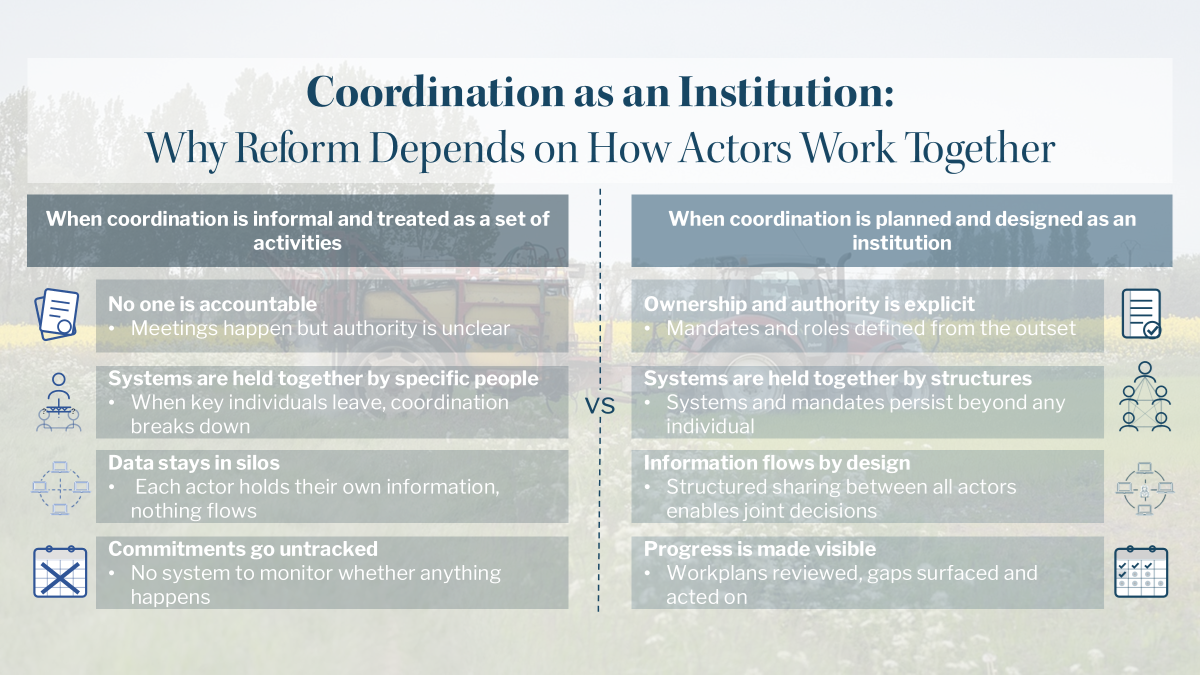
Agricultural reform rarely fails for lack of actors. Ministries, development agencies, donors, private firms, and civil society organisations are usually present, often well-funded, and frequently active. The challenge is not their absence. It is how they work together.
In many reform processes, coordination is treated as a secondary activity: meetings are convened, information is shared, and working groups are stood up, but without clear mandates, structured accountability, or any mechanism to track whether commitments are being honoured. Over time, fragmentation re-emerges. Momentum slows and parallel workstreams drift apart.
From our experience supporting agricultural and rural development reform in Southern and West Africa, effective and meaningful coordination has consistently been one of the most important determinants of whether reform delivers.
Coordination shapes outcomes, not just processes
Coordination is often framed as a process issue, a way to keep stakeholders informed or avoid duplication. In practice, it directly shapes outcomes. When coordination mechanisms are weak, policies are implemented unevenly. Investments become misaligned with stated priorities. Parallel initiatives compete for the same institutional bandwidth, with officials managing multiple overlapping demands and little clarity on which takes precedence. Even where funding is available and technical capacity exists, the absence of structured coordination limits what can be delivered.
In Zambia, for example, the design of three proposed new market institutions, an Agricultural Marketing Council, a Market Observatory, and a Warehouse Receipts Authority, illustrates this challenge. Each institution has distinct core functions. But their mandates overlap substantially, particularly around market and industry coordination, research and data analysis, and warehouse oversight (See diagram 1 below).
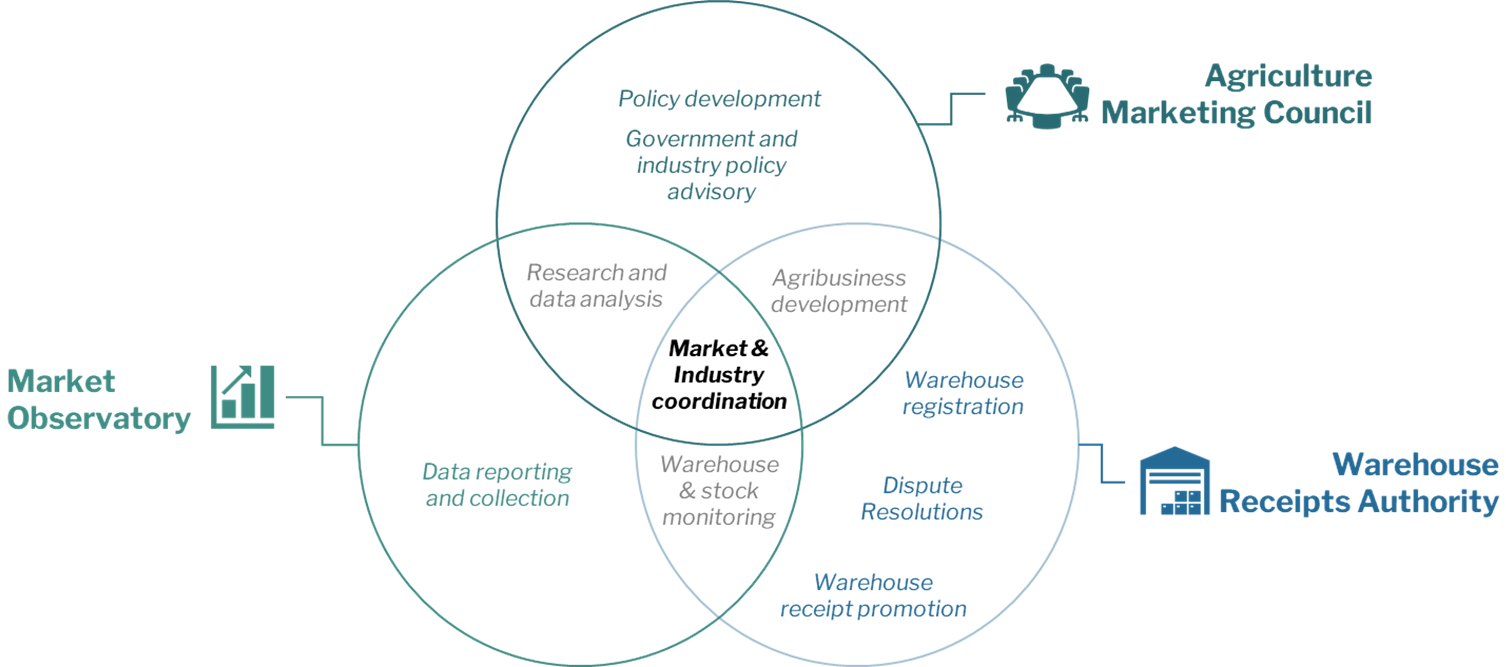
Diagram 1: Proposed new institutional structure for the Zambian Agricultural sector
Without deliberate coordination design, these overlaps do not resolve themselves. They become points of institutional friction, each body defending its mandate, duplicating work, and creating confusion for the private sector and government counterparts trying to engage with the system. The reverse is equally true: where coordination is designed in from the outset, these overlaps become opportunities for complementarity rather than sources of conflict.
Effective coordination requires institutional design — the Mozambique example
Effective coordination does not emerge organically from goodwill or shared objectives. It requires deliberate institutional design.
In Mozambique, ThirdWay Partners has served as secretariat of the Multistakeholder Platform for Northern Mozambique (MSP), a structured coordination mechanism bringing together government, development partners, civil society, and private sector actors to support the sustainable development of the Northern Region. The MSP has operated through periods of significant disruption, climate shocks, insurgency, and sustained pressure on economic activity. This resilience has resulted not from the goodwill of any individual participant, but on the institutional infrastructure behind it.
In practice, this has meant clear terms of reference, defined roles for participating institutions, agreed annual workplans, and regular reporting against shared indicators. Coordination through the MSP has gone beyond information sharing. The platform has been used to track commitments, surface gaps in implementation, and adjust priorities in response to evidence. Over more than five years, this has helped align government, donor, and private sector activity in a region where misalignment would have been easy and costly.
The lesson is consistent with what we have seen elsewhere: without an institutional backbone, coordination becomes episodic and dependent on individual relationships rather than durable systems. When those individuals move on, the coordination disappears with them.
Information only creates value when it is shared and used
One of the most common coordination failures in agricultural reform is the fragmentation of information. Data on funding flows, production and supply, sector activities, and policy developments often exists across multiple institutions, but it sits in separate systems and updated on different cycles. It is rarely brought together in a way that enables joint decision-making.
Across several countries and regions, our market systems analysis found that this fragmentation was one of the most significant structural weaknesses across the entire agricultural information ecosystem. The data exists, but the flows between producers, traders, government bodies, and processors are broken at multiple points reducing the ability of these actors to coordinate effectively.
The diagnosis runs deeper still. Looking specifically at the agricultural information ecosystem, the blockages appear at every level: data sources that withhold information to protect commercial advantage, intermediary bodies producing forecasts with known inaccuracies, and decision makers at government level planning based on systematically incomplete data.
Where coordination mechanisms include structured information and knowledge management functions, the quality of decision-making improves. Shared datasets and regular reporting help actors understand who is doing what, where gaps exist, and where complementarities can be leveraged rather than duplicated. This has proven particularly important in contexts with multiple active development partners.
Transparent information flows help align investments with national priorities, reduce unintended distortions, and give governments a clearer picture of the total resource envelope they are working with. A good example of this can be found in South Africa (see diagram 2 below), were a mix of public and private institutions have created a transparent system of information sharing that enhances coordination for all market players.
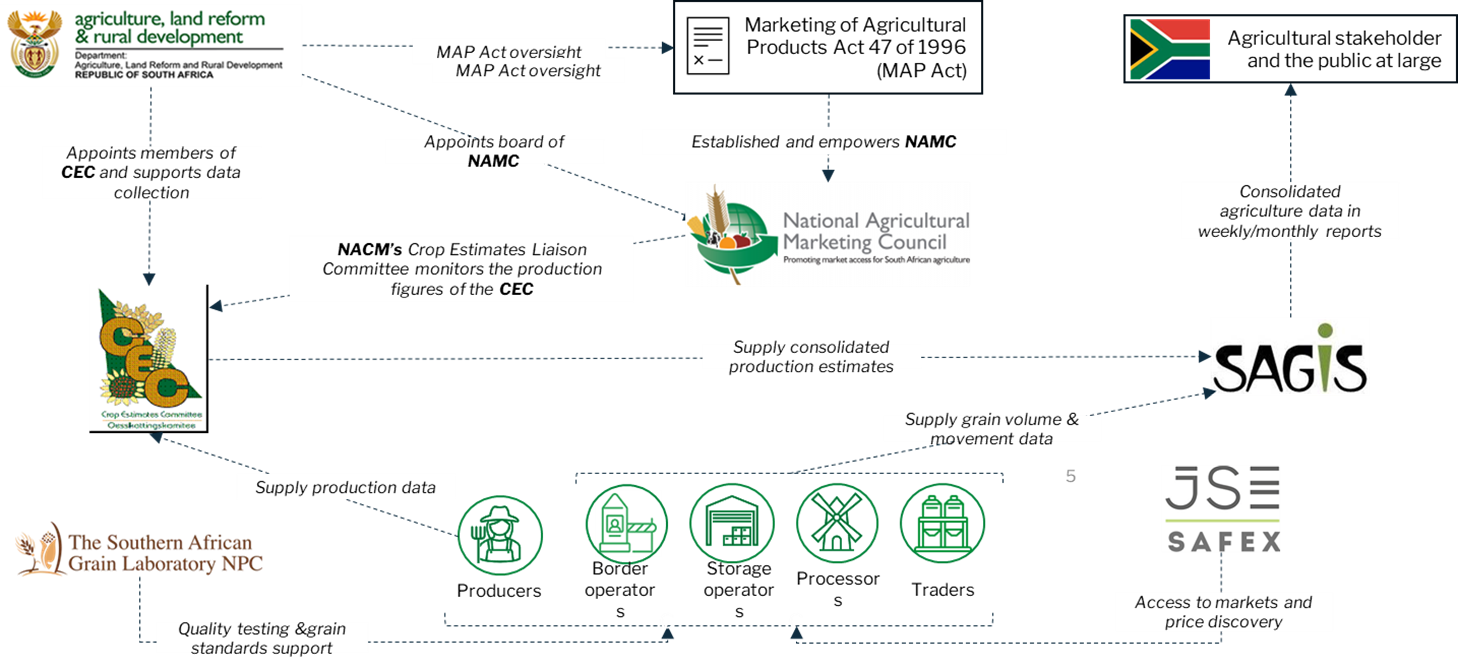
Diagram 2: South African agricultural information ecosystem
Coordination becomes more complex at regional scale — lessons from West Africa
The coordination challenge is amplified when reforms extend beyond national borders. Regional initiatives in areas such as soil health, land use, and market integration require alignment not only across institutions within a country, but across governments, regional bodies, research organisations, and international partners.
In West Africa, ThirdWay Partners supported AGRA in developing a convening strategy for the Soil Values programme, focused on improving soil health and agricultural productivity across the Sahel. The work involved mapping and aligning diverse stakeholder groups across multiple countries to identify shared priorities, strengthen collaboration, and ensure that national and regional efforts were reinforcing rather than cutting across each other.
What this process made clear is that coordination at regional scale requires explicit frameworks that define how different levels interact. Local actors, national authorities, regional bodies, and international partners all have legitimate roles. Without clarity on how those roles connect, coordination collapses at exactly the points where it matters most: where mandates overlap and responsibilities are genuinely shared.
Making coordination implementation-ready — what it looks like in practice
Treating coordination as an institution rather than an activity changes how reform is designed from the outset. Ethiopia's agricultural sector offers an instructive example of what this looks like in practice (See diagram 3 below).
The Ministry of Agriculture sits at the centre of a deliberately structured coordination architecture. It is not simply a regulator, but an institutional anchor connecting specialised government agencies, private companies, and development partners across the sector. The Agricultural Transformation Institute addresses systemic bottlenecks. The Ethiopian Agricultural Authority sets practice standards. The Ethiopian Commodity Exchange modernises markets. Each has a distinct mandate, but the Ministry provides the coordinating frame that prevents those mandates from fragmenting into parallel, unconnected activity.
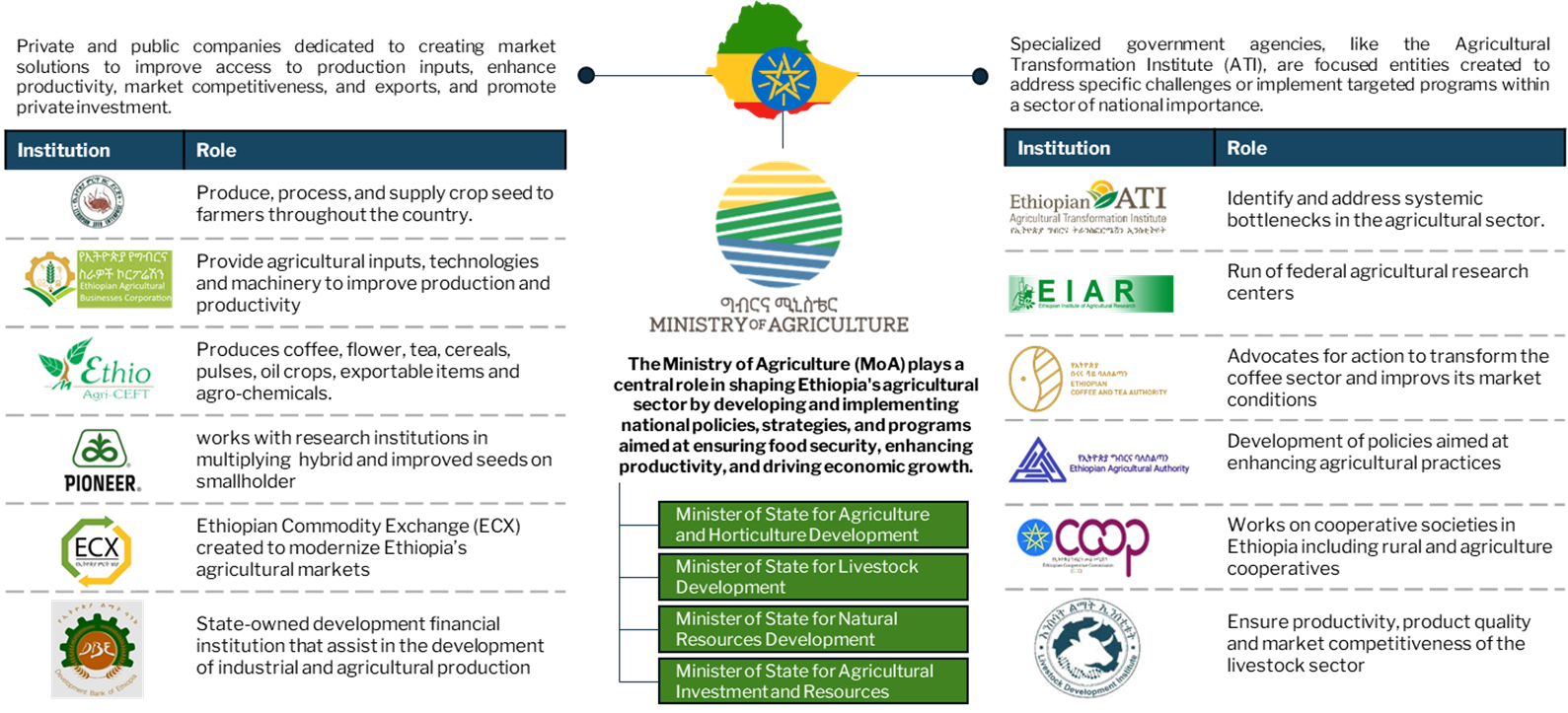
Diagram 3: Ethiopian agricultural coordination
What makes this notable is not the presence of multiple institutions, most agricultural systems have those. It is that the roles are explicit, the relationships between them are designed, and coordination sits at the centre rather than being left to informal negotiation between actors with overlapping interests.
As agricultural reforms grow more complex and multi-actor in nature, the importance of getting coordination right will only increase. Predictable rules and well-designed policies are necessary conditions for reform, but they are not sufficient on their own. Without strong coordination institutions to hold actors to account and maintain alignment over time, even the best-designed reforms will underdeliver.
Questions worth asking early
Reform processes that take coordination seriously tend to surface a different set of design questions upfront. Implementation-ready reform asks a set of practical questions that are often left unanswered until problems emerge:
Who is responsible for convening, and do they have a clear mandate to do so?
How will priorities be set jointly, and what happens when they conflict?
What information needs to be shared across actors, and is there a system to do that reliably?
How will commitments be tracked, and what happens when they are not met?
When key individuals move on, what institutional structures ensure coordination continues?
Reforms that engage with these questions at the design stage, rather than discovering their absence once implementation stalls, are far more likely to translate from plans into lasting results.
In the next article in this series, we will turn to access to finance and explore how institutional coordination shapes the effectiveness of rural financing instruments and investment facilities.