
Proven on Cost, Stuck on the Road
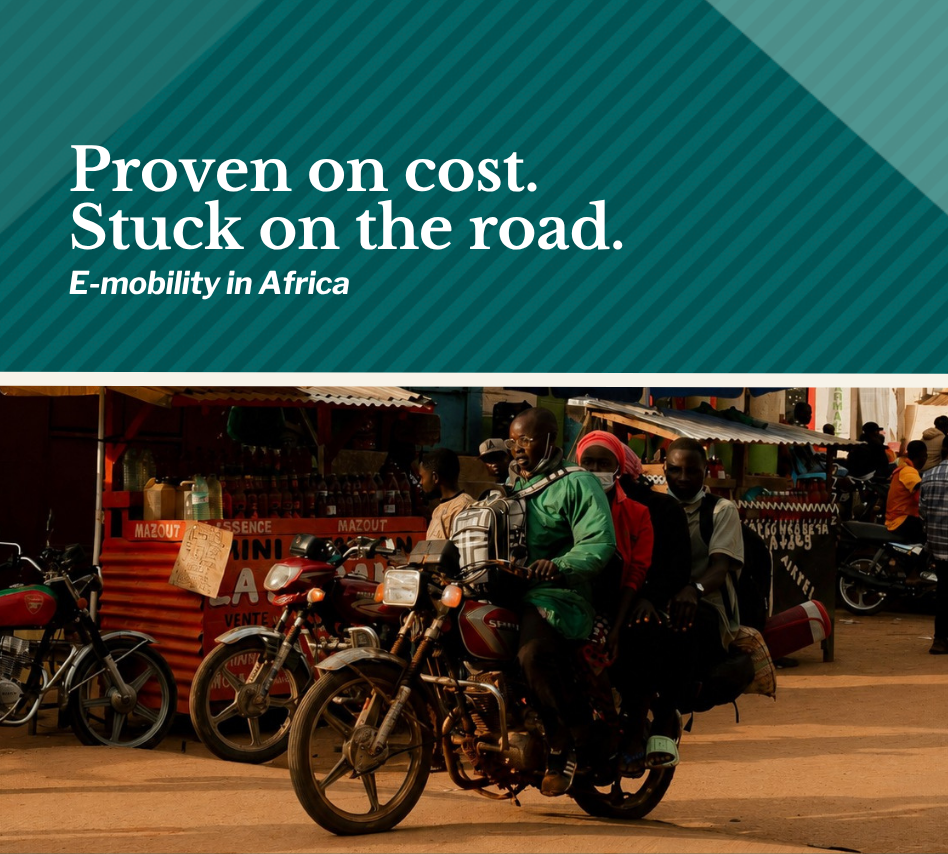
Across much of Africa, electric two- and three-wheelers already outperform petrol equivalents on total cost of ownership. The technology is established; what remains constrained is access to the credit required to meet the upfront purchase price.
For more information, contact Martin del Pino (Associate Director) - mdelpino@thirdway.earth.

Lower Operating Costs Have Not Yet Translated into Adoption
Africa's electric mobility transition originated in a straightforward calculation by commercial riders: a comparison of the daily cost of petrol and maintenance with the cost of operating an electric motorcycle. On a five-year cash basis, electric two- and three-wheelers can now be 40 to 60 percent cheaper to own than their petrol equivalents. The cost case is well established.
Adoption has nonetheless lagged. In Mozambique, fewer than 150 electric two- and three-wheelers were estimated to be on the road in 2024. Resistance seldom concerns the vehicle itself. It concerns the upfront price and the absence of credit to finance it. Where finance has closed that gap, in markets such as Kenya, Uganda and Rwanda, adoption has accelerated.
Why Two- and Three-Wheelers Lead Africa's Electrification
Africa's electric vehicle transition is occurring predominantly on two and three wheels rather than four. Motorcycles and three-wheelers are core urban and peri-urban transport across sub-Saharan Africa, and in many markets up to 80 to 90 percent are used for taxis, delivery and other commercial activity. These vehicles are in near-continuous daily use, typically covering 100 to 130 km a day4.
This intensity of use underpins the economic case for electrification. A high-mileage rider spends a large share of daily earnings on fuel and maintenance, so even a modest saving per kilometre compounds quickly. Savings scale with distance travelled, which explains why electric two-wheelers represent the leading entry point for e-mobility on the continent. With more than 27 million registered motorcycles in sub-Saharan Africa, even modest electric penetration represents a large clean-transport opportunity, and a commercial opening for manufacturers, financiers, charging operators and investors that can adapt their models to local conditions1.
Evidence of Market Scale-Up
Africa's electric two-wheeler market has progressed beyond the pilot stage. Sales reached about 70,000 electric two-wheelers across Africa in 2025, over 80 times the level at the start of the decade, according to the IEA's Global EV Outlook 20262. Growth remains concentrated in a small number of leading markets. In Kenya, electric motorcycles reached about 15 percent of new motorcycle registrations in 2025 (more than 25,000 units)3, while Uganda recorded more than 30,000 electric two-wheeler sales over the same year2.
Infrastructure is expanding alongside the fleet. By mid-2026, battery-swapping operator Spiro reported more than 100,000 electric motorcycles, over 2,500 battery-swapping stations and more than 30 million battery swaps across seven active African markets: Kenya, Uganda, Rwanda, Nigeria, Benin, Togo and Cameroon5. Policy has also begun to respond. Rwanda estimates that a full transition to electric motorcycles could save around US$22 million in fuel imports each year6, and Ethiopia banned the import of internal-combustion vehicles in 2024 to curb its oil-import bill2. Rider economics, infrastructure and policy are becoming increasingly aligned.
Total Cost of Ownership Favours Electric
The principal barrier to adoption is consistent across markets: upfront cost. Electric motorcycles and three-wheelers cost more at the point of sale than petrol equivalents, roughly 1.5 times the price of a comparable petrol bike. For operators working on narrow margins, that differential can be prohibitive.
Over a five-year horizon, the position reverses. In a market study commissioned by AECF and supported by Sida, ThirdWay Partners found that electric motorcycles and three-wheelers in Mozambique could deliver 40 to 60 percent lower cash total cost of ownership. The modelled saving was US$5,500 to 6,200 for a motorcycle user and US$9,000 to 12,000 for a three-wheeler taxi operator1.
For the commercial users surveyed, those operating savings could add US$3 to 5 to daily net income, equivalent to an estimated 50 to 65 percent uplift depending on the vehicle. High-utilisation fleets and owner-drivers should therefore remain the lead adopters.
Figure 1: Five-year total cost of ownership for petrol and electric two- and three-wheelers (US$)
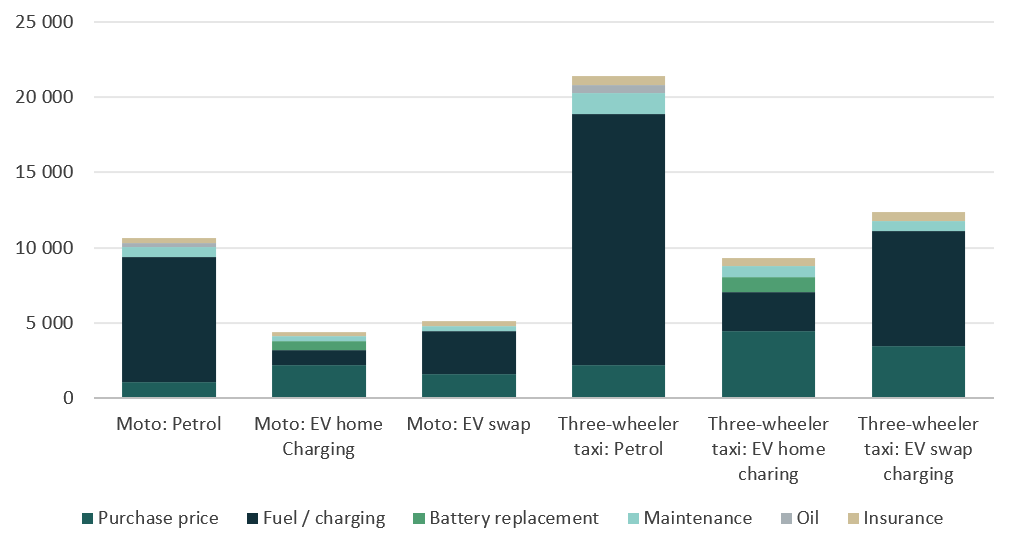
Electric vehicles are 40 to 60 percent cheaper on a cash-cost basis, with the largest gains for high-mileage commercial operators. Bars show the five-year cost stack for each option. Source: AECF Market Study on E-Mobility in Mozambique (2025), based on survey results, market interviews and modelled assumptions.
Bridging the Upfront Gap: The Role of Finance in Market Formation
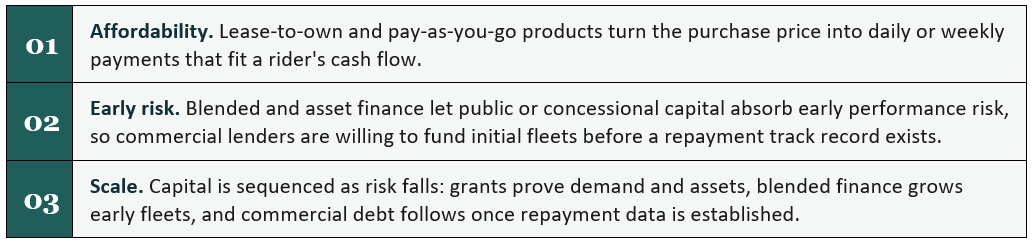
Given that the vehicle is already competitive on cost, the operative question is how a rider finances the purchase. Scale accelerated in markets such as Kenya and Rwanda when financing models began to close the upfront gap. The model works when the rider's operating savings exceed the daily repayment, allowing the vehicle to be partly self-financing. Financing is part of the core e-mobility business model.
Formal credit provision remains limited. In the Mozambique survey, only 18 percent of users had bought their vehicle with a loan, and just 30 percent of those loans came from formal institutions. Most riders still buy in cash, rent, or rely on informal finance, with the result that lower running costs do not translate into purchases. Closing this gap follows a discernible sequence:
Battery Swapping and the Downtime Constraint
For high-use commercial riders, battery swapping has emerged as the leading alternative to home charging. A rider can exchange a depleted battery for a charged one in minutes, avoiding several hours of downtime and moving the battery cost out of the vehicle purchase and into a recurring service fee.
The model is expanding across borders. Spiro's network spans Kenya, Uganda, Rwanda, Nigeria, Benin, Togo and Cameroon5, while Ampersand, Zembo, Roam and Arc Ride are applying variants of the model in East Africa, from staffed stations to automated cabinets and app-based access. Swapping is well matched to prevailing operating conditions. Household electricity access and grid reliability remain uneven, and commercial riders cannot afford long charging stops. Swapping stations reduce downtime, remove the need for a home connection and make battery replacement a predictable operating cost. Scaling the model is capital-intensive: each station requires investment in batteries, charging equipment, grid connection and site infrastructure, and networks must be built ahead of fleet growth to be useful to riders. Swapping infrastructure is therefore an investment opportunity in its own right, alongside the vehicles themselves.
Determinants of Market Readiness
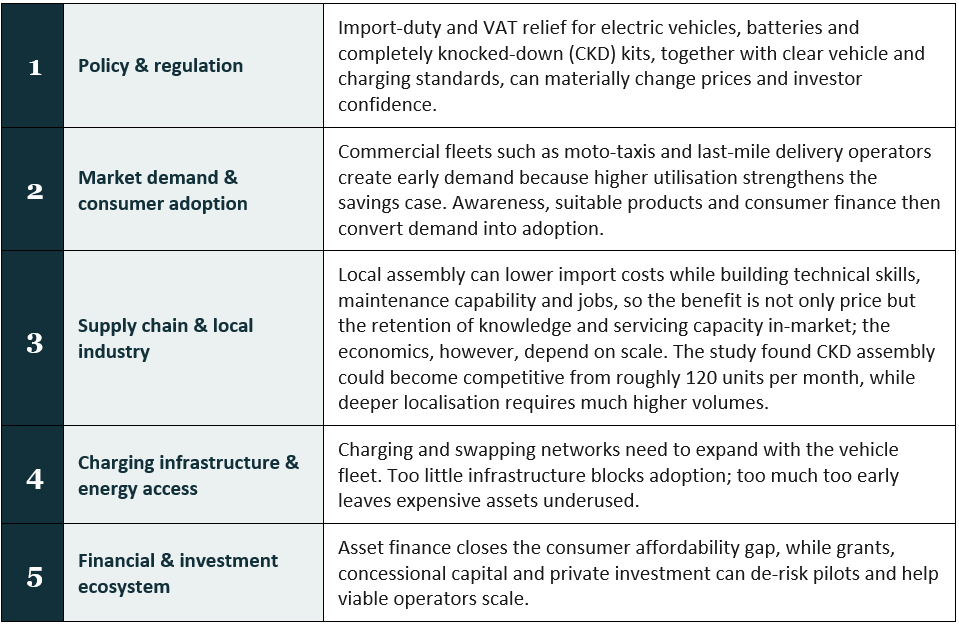
Kenya and Rwanda illustrate the characteristics of early scale, and Uganda is advancing rapidly. The same underlying conditions exist across East, West and Southern Africa: large commercial fleets, rising urban demand, high fuel costs and, in many countries, increasingly clean electricity. ThirdWay Partners' market study for AECF combined fieldwork in Mozambique with regional comparisons to identify five conditions that determine how quickly a new market can move1:
Mozambique as a Next-Wave Market
The AECF study focused on Mozambique, but its relevance is regional: it demonstrates how a market may exhibit strong fundamentals while registering negligible adoption. Mozambique has around 320,000 two- and three-wheelers and annual sales of roughly 35,000 to 50,000 units, and moto-taxis are central to commercial transport in major cities outside Maputo.
Yet the study estimated fewer than 150 electric two- and three-wheelers on the road in 2024, equal to less than 0.5 percent of annual sales. In the survey of 450 users, only one respondent owned an electric vehicle. Mozambique has not yet reached a tipping point: latent demand is present, but the enabling environment is not.
The demand indicators are nonetheless strong. Seventy-six percent of surveyed riders were aware of electric motorcycles and 79 percent would consider switching if charging infrastructure were available. Cost savings were the leading motivation, with 35 percent citing lower fuel costs and 25 percent reduced maintenance; only three respondents saw no benefit in switching. The obstacles were upfront price, charging availability and confidence in battery durability1.
Figure 2: Key concerns of riders considering electric vehicles, survey of 450 users (share of responses)
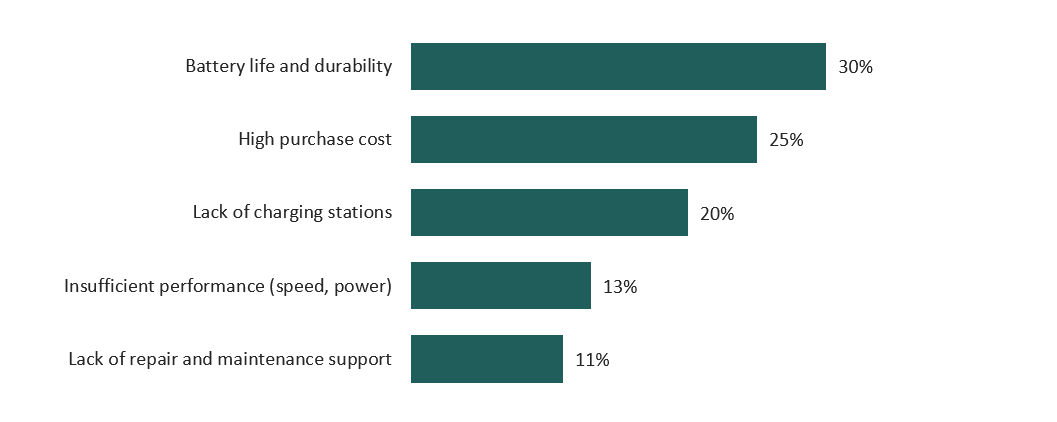
Battery durability and purchase price are the leading concerns, mirroring the financing, infrastructure and trust gaps seen across regional markets. Source: AECF Market Study on E-Mobility in Mozambique (2025), survey results and enumerator insights.
Grid Carbon Intensity and the Emissions Case
The emissions case for electric motorcycles is especially strong in countries with low-carbon electricity. On Mozambique's hydro-heavy grid, an electric motorcycle produces about 5 g of CO₂ per kilometre, compared with 66 g for petrol. Hydropower supplied 83 percent of the country's electricity in the study's 2022 baseline, and grid carbon intensity was about 136 gCO₂e/kWh, around 68 percent below the African average1.
Comparable conditions prevail elsewhere. Ethiopia, Uganda, Malawi, Kenya and Zambia all sit well below the African grid-carbon average. For high-mileage commercial vehicles, that clean-grid advantage compounds with daily utilisation.
Figure 3: Lifecycle carbon intensity of electricity across selected African e-mobility markets, 2022 (gCO₂e/kWh; lower is cleaner)
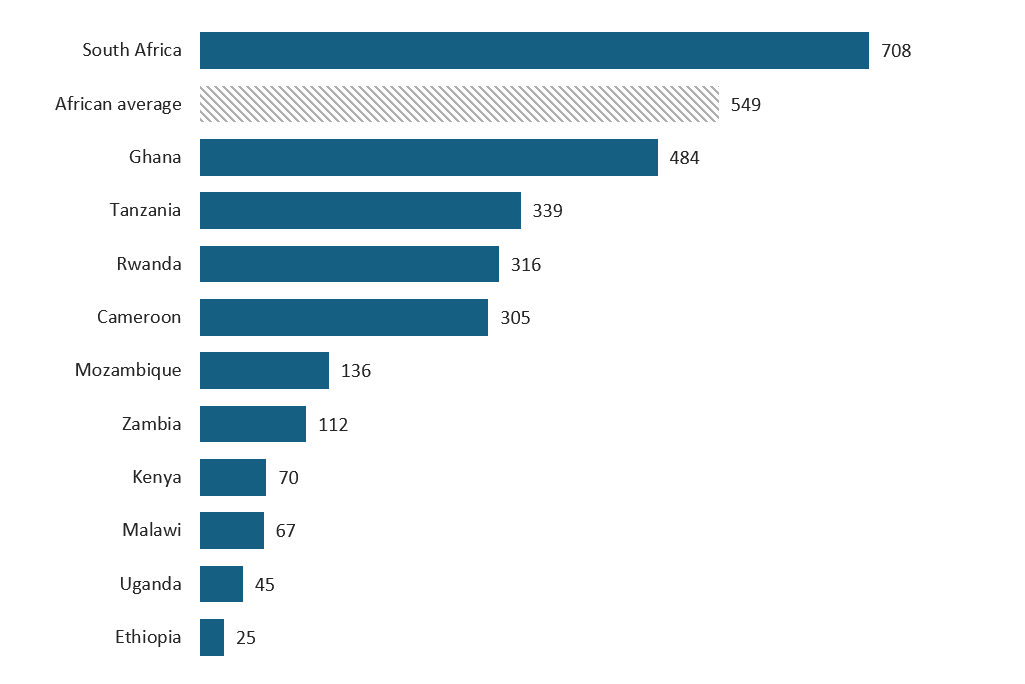
Several next-wave markets sit far below the African average (shown for reference). Source: AECF Market Study on E-Mobility in Mozambique (2025), using Our World in Data figures adapted from Ember. Values in gCO₂e/kWh, rounded to the nearest whole number; selected markets shown.
In Mozambique, the supportive-growth scenario modelled a fleet of 5,300 electric two- and three-wheelers by 2030. Under the study's assumptions, that fleet would avoid about 15,000 tonnes of CO₂ each year, with cumulative savings of roughly 215,000 tonnes over the vehicles' modelled operating lives through 2034. The benefits extend beyond emissions. For fuel-importing economies, electrification supports energy security and the balance of payments by reducing exposure to oil prices and foreign-exchange volatility, while local assembly, maintenance and charging keep more of the mobility value chain on the continent.
The Pace of Transition in Next-Wave Markets
Operators are expanding across borders, capital is entering the sector and commercial riders are demonstrating the economics. What differs between markets is the speed at which the conditions for scale can be established. The AECF scenario analysis quantifies the cost of delay: for Mozambique, modelled annual electric two- and three-wheeler sales in 2030 ranged from about 1,300 under the status quo to 5,300 with supportive conditions and 10,500 under an accelerated transition. Those figures are specific to Mozambique, but the requirement holds across the region: policy, finance, infrastructure and supply need to move together.
The technology is already competitive on cost. The outstanding requirement is affordable credit, which structured asset finance, blended capital and patient investment are well placed to provide.
About this research
This article draws on the AECF Market Study on E-Mobility in Mozambique, commissioned by the Africa Enterprise Challenge Fund (AECF), supported by Sida and prepared by ThirdWay Partners. The work combined a survey of 450 motorcycle and three-wheeler users across Maputo, Nampula and Zambezia with stakeholder interviews, market modelling and a comparative review of peer African markets. Regional figures are drawn from the published sources listed below.
Sources
1. FIA Foundation / Amend / FIM (2022). The Wheels of Change; and Cleantech Group / Factor[E] Ventures (2024), The Rise of Two and Three-Wheelers in Africa. Registered motorcycle stock in sub-Saharan Africa.
2. International Energy Agency (2026). Global EV Outlook 2026. African electric two-wheeler sales in 2025 and Uganda sales; Ethiopia import policy.
3. CleanTechnica (2026). Electric Motorcycles Reach 15.3% Market Share of New Registrations in Kenya in 2025, citing KNBS and EMAK data.
4. McKinsey & Company (2022). Power to Move: Accelerating the electric transport transition in sub-Saharan Africa. Commercial rider daily mileage.
5. Spiro (2026). Company disclosures on fleet, battery-swapping stations, swaps and active markets, mid-2026. Spiro news.
6. Rwanda Ministry of Infrastructure (2021). Rwanda is building climate resilient transport systems. Estimated annual fuel-import saving.
7. Africa Enterprise Challenge Fund (AECF) (2025). Market Study on E-Mobility in Mozambique: Final Report. Internal report supported by Sida and prepared by ThirdWay Partners. Contact ThirdWay Partners for more information.
8. Our World in Data, based on Ember. Carbon intensity of electricity generation.