
Designing for Resilience: Financing Agribusinesses in Fragile Contexts
Conventional finance is built for stability. It assumes predictable production, reliable transport, functioning markets, and borrowers whose income disruptions are temporary.
In fragile and conflict-affected markets, those assumptions rarely hold.
For agribusinesses, this mismatch is particularly stark. Food systems depend on the enterprises that grow, aggregate, transport, process, and sell food. Yet these same businesses often operate in environments shaped by conflict, displacement, climate shocks, damaged infrastructure, thin public services, and repeated market disruption. A cyclone can flatten crops and wash out feeder roads. Conflict can close supply routes and displace both customers and suppliers. Currency instability can reshape how people save, borrow, and transact.
When financial products are designed for stable markets and then deployed in volatile ones, they often fail. Lenders read those losses as proof that the market is uninvestable. Risk appetite falls. Capital retreats. The businesses most central to keeping food systems functioning are left without the finance they need.
This is not a marginal issue. Fragile and conflict-affected contexts are increasingly where poverty, hunger, and humanitarian need are concentrated. By 2030, close to 60% of the world’s poorest people are projected to live in fragile and conflict-affected states. Around 70% of people facing acute food insecurity already live in fragile or conflict-affected countries. Fragility is economically corrosive too: on average, conflict lowers GDP growth by around two percentage points a year. These are precisely the markets where resilient food systems matter most, and where conventional finance is most likely to withdraw.
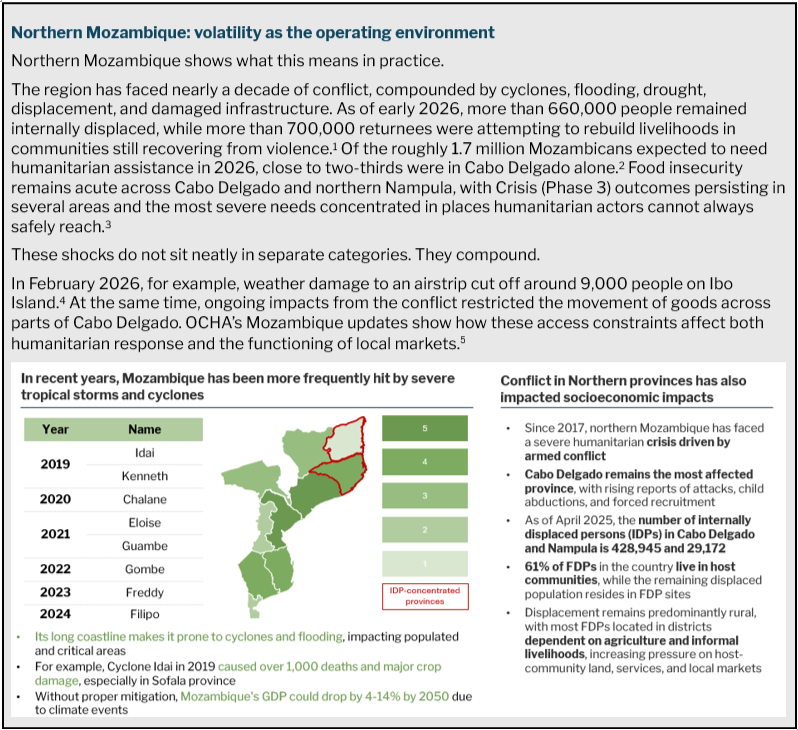
When roads close, goods stop moving. Families lose access to markets, income, and services. Farmers miss harvests. Traders cannot reach buyers. Health services are interrupted. Households already displaced by conflict are pushed deeper into hunger.
For businesses, this creates an operating environment that is viable but highly volatile. Many MSMEs are not inherently uncommercial. They are simply too informal, too exposed, or too disrupted to meet conventional lending criteria. Yet their survival often determines whether food continues to move through local markets.
What we have learned designing finance across fragile markets
Across our work with financial institutions, donors, agribusinesses, and local partners in fragile markets, one lesson has become clear: finance has to be designed around the realities of volatility, not around the hope that volatility will disappear.
1. Design for volatility, not repayment perfection
In fragile contexts, risk is not an externality to price in after the fact. It is a core design constraint.
Even strong businesses may face interruptions that make a standard repayment schedule unrealistic. A trader may lose access to a key route. A processor may see suppliers displaced. A farmer-facing aggregator may have to absorb climate losses across its network. A borrower may still be viable, but not on a product designed for stable cash flows.
This means loan tenors, grace periods, repayment profiles, collateral requirements, guarantees, insurance, and restructuring mechanisms need to reflect how businesses actually operate.
The better question is about how financing structures can allow businesses to keep operating when conditions deteriorate.
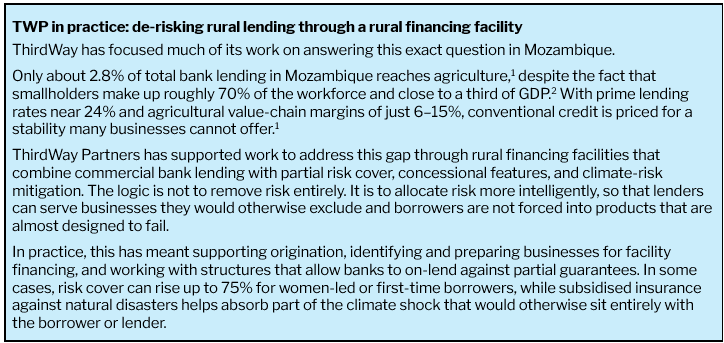
Sources: 1) GIZ Ag Finance Report, 2) World Bank
2. Finance real market relationships
Resilience is rarely built through isolated enterprises. It is built through the relationships that keep markets functioning.
In agricultural systems, those relationships include aggregators buying from farmers, traders moving produce, processors creating demand, input suppliers extending credit, and local service providers keeping production and commerce moving.
This does not replace the need for farmer-level finance. Smallholders remain central to food systems. But in fragile contexts, financing only at the producer level can miss the businesses that create market access for many others.
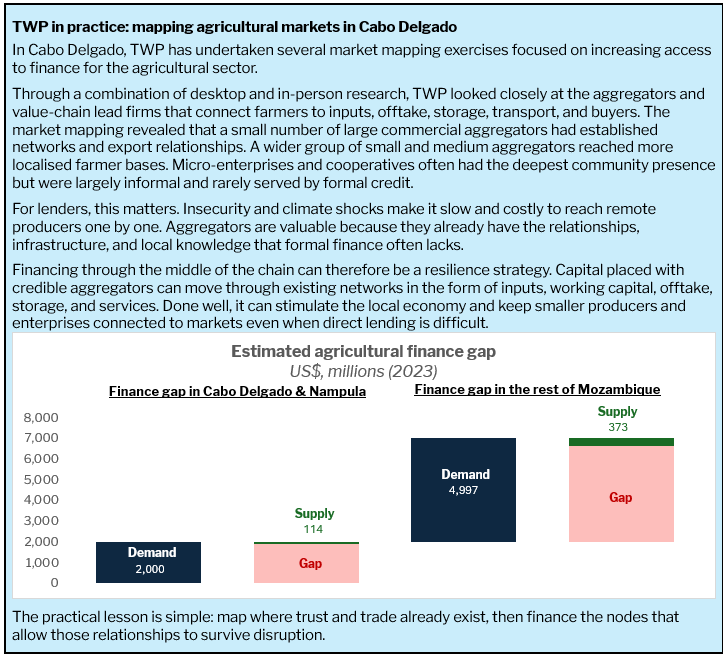
The scale of this channel is significant. Cotton alone links around 170,000 Mozambican smallholders to milling companies that advance inputs on credit, and close to 12% of the country’s rural population is tied into some form of aggregation relationship. A World Bank evaluation of seven Mozambican aggregation schemes found that expanding these schemes raised growers’ incomes in most cases, while only half of the aggregating firms turned a profit within three years. That is a useful reminder: market-making businesses may need patient or concessional capital to keep going, and the public support required to sustain them can be relatively modest.
3. Pair finance with the support required to make businesses investable
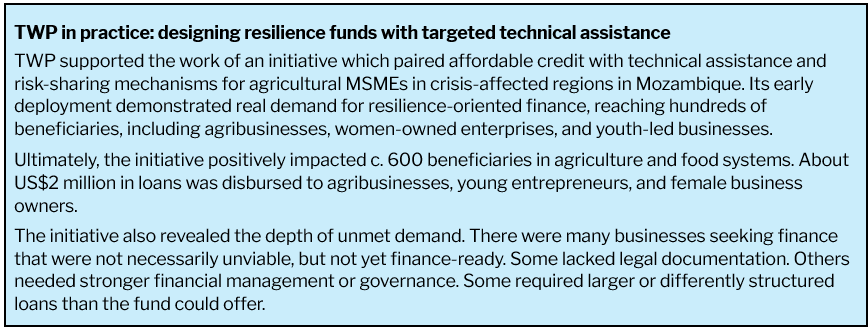
Many businesses in fragile contexts are excluded from finance not because they lack commercial potential, but because they cannot meet the formal requirements of the financial system.
They may lack documentation, legal registration, financial records, governance structures, management systems, or collateral. They may have real demand, real customers, and real growth potential, but still fail a lender’s readiness test. The exclusion is stark: national survey data show only about 0.6% of smallholders in Mozambique have access to formal credit, and just 2% reach any third-party financing at all.
This is why technical assistance cannot sit beside finance as a separate workstream and should rather be built into the financing model. Business diagnostics, legalisation support, financial management, governance capacity, and market linkages are often what convert latent demand into bankable demand.
4. Make coordination part of the design
In fragile contexts, finance does not operate in isolation. Humanitarian response, government priorities, market recovery, community institutions, and private-sector investment all shape whether capital can be deployed effectively.
Without coordination, finance risks fragmentation. It may duplicate existing efforts, miss local priorities, or reach communities before the conditions for absorption are in place.
With coordination, finance can reinforce recovery rather than operate around it.
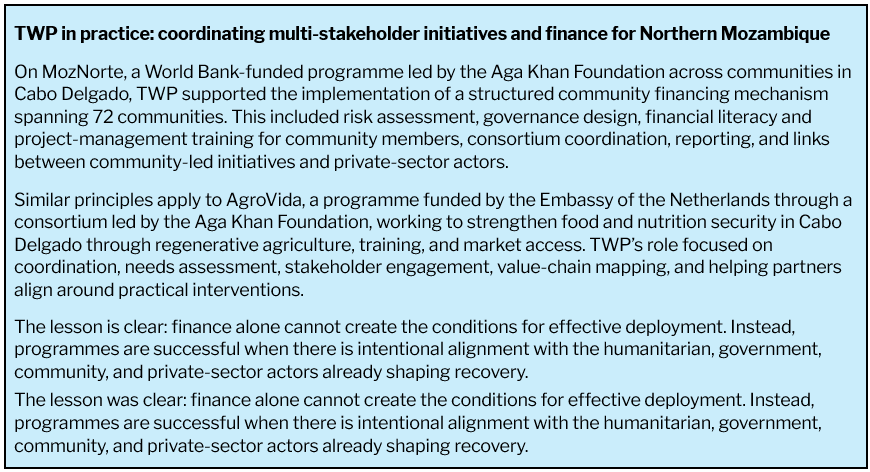
In stable markets, coordination is often treated as process. In fragile markets, it is delivery infrastructure.
Conclusion: what sound finance looks like in fragile markets
Businesses in fragile contexts are not inherently unfinanceable. Too often, the instruments available to them are built for a world they do not operate in.
Resilience finance starts from a different premise, assuming volatility from the beginning.
That means structuring products around disruption rather than pretending it is exceptional. It means financing the market relationships that keep food systems functioning. It means treating trust, technical assistance, and coordination as core parts of the financial model. It means using concessional capital to build durable delivery mechanisms, not simply to subsidise short-term lending.
This is not a compromise on financial discipline. It is what financial discipline looks like in a fragile market.
If the goal is to build sustainable food systems in the places most exposed to conflict, climate shocks, and hunger, then finance must be designed for the conditions businesses actually face.