
What Implementation-Ready Agricultural Reform Really Looks Like

Agricultural reform strategies across Africa are rarely short of ambition. National plans routinely aim to raise productivity, stabilise food systems, improve farmer incomes, attract private investment, and boost export volumes. In many cases, these strategies are technically sound and aligned with international best practice. Based on the quality of written strategies alone, Africa should be delivering far more.
Yet outcomes consistently fall short.
From our work supporting agricultural reform in Southern Africa and the Sahel, this gap is rarely explained by a lack of strategy or even policy. In most cases, both exist. The challenge lies in implementation and specifically in whether three critical elements are in place: solid policy that translates strategy into rules of engagement, institutions with the capacity to deliver, and meaningful private sector collaboration to unlock the capital and momentum that government alone cannot provide. Without all three, even the most ambitious agricultural strategy will stall between intention and impact.
This article draws on select ThirdWay Partners experience across Zambia, Mozambique, and regional Sahel initiatives to make the case for what implementation-ready reform looks like in practice.
Moving beyond the strategy perfection to implementation excellence
A common instinct in agricultural reform is to focus on refining strategy or policy. But in many of the countries we work in, the strategies are already well developed. The Maputo Declaration, CAADP frameworks, and dozens of national five- and ten-year plans set ambitious targets. Zambia has multiple comprehensive frameworks, from the National Agricultural Policy to CATSP, that define sector priorities in detail. Mozambique's priorities are clearly articulated in its National Five-Year Plan (2020–2025), alongside long-term agricultural and investment strategies.
The challenge is not a lack of ambition on paper. It is translating that ambition into coordinated, sustained action across complex institutional landscapes, and in genuine partnership with the private sector. This is where most reforms stall: not because of weak design, but because of the realities of implementation.
Lesson 1: Reform often extends beyond national borders — the Soil Values example
Agricultural systems do not stop at country boundaries. Value chains, ecosystems, and markets are frequently regional, and implementation frameworks that ignore this are limited from the outset.
This is particularly evident in soil health and land-use initiatives across the Sahel. Efforts to improve agricultural productivity depend on coordination across countries, requiring alignment among policymakers, researchers, communities, and regional actors who do not always share the same priorities or timelines.
AGRA engaged ThirdWay Partners to develop a convening strategy for the Soil Values programme, focused on improving soil health and agricultural productivity across the Sahel through coordinated, multi-level stakeholder engagement. The work involved mapping and aligning diverse stakeholders, including policymakers, researchers, communities, and regional and international actors, across multiple countries to identify priorities, strengthen collaboration, and ensure inclusive participation.
This process culminated in a shared strategy and workshop that integrated cross-sector perspectives, enabling coordinated action and longer-term impact on sustainable land management and soil health. The lesson is that implementation readiness sometimes depends on building shared agendas across borders, and designing for that from the outset, not treating it as an afterthought.
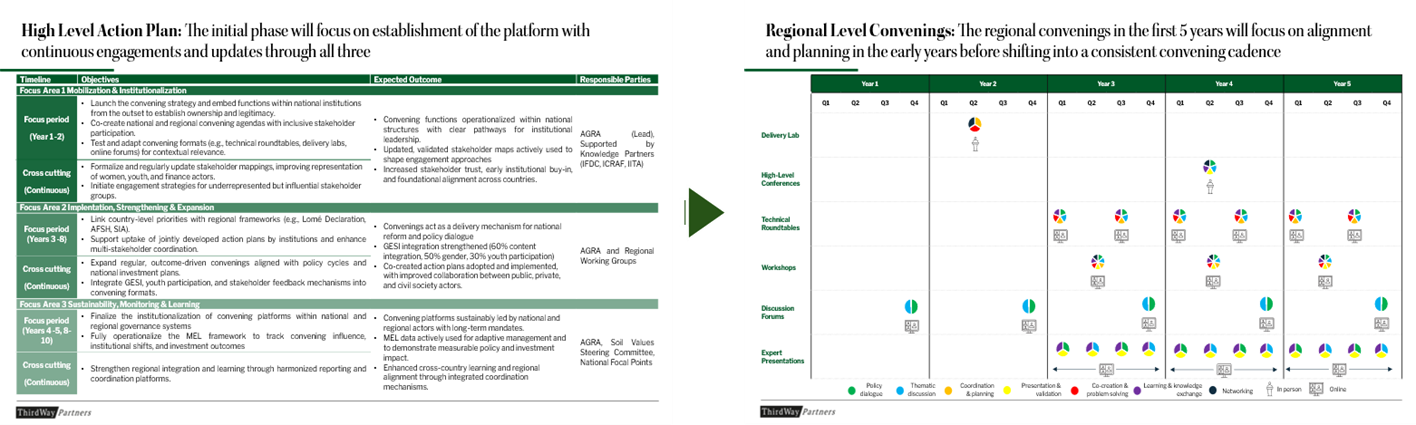
[Image: Soil Values convening strategy diagram — moving from high-level objectives into concrete, granular action plans]
Lesson 2: Coordination is the work, not the afterthought — the Mozambique MSP
Agricultural reform is inherently multi-actor. Implementation cuts across ministries, regulators, parastatals, local authorities, development partners, and private sector actors. Where coordination is treated as secondary to strategy, progress slows quickly.
ThirdWay Partners has seen this in action through our role as secretariat of the Multistakeholder Platform for Northern Mozambique (MSP). The MSP is a structured space for information-sharing and coordination that aims to support the sustainable development of Mozambique's Northern Region. It brings together the Mozambican government, non-governmental organisations, donors, civil society, and private entities.
Through a sustained period of significant disruption, climate shocks, insurgency, and consistent pressure on social and economic activity, the MSP maintained lines of communication between key stakeholders for over five years. Its value has not been in redefining strategy, but in sustaining coordination through uncertainty.
The lesson is straightforward: implementation requires structures that enable continuous alignment across all relevant actors, not one-off consultation events.
Lesson 3: Reform must reflect institutional reality — Zambia as a forward-looking case
Well-designed reforms often assume clear mandates, aligned incentives, and predictable processes. In practice, institutions are rarely this tidy, and reforms that do not reckon with that reality tend to stall.
In Zambia, several agricultural reforms, including the Agricultural Marketing Bill, have been under consideration for over a decade. The Bill was originally developed in the mid-2000s but lay dormant from 2010. It was revived by the Ministry of Agriculture in 2024 following significant consultation across the private, public, and donor communities. Earlier efforts had stalled due to a failure to align the reform with the full range of stakeholder needs, competing mandates, misaligned incentives, and insufficient engagement across the sector.
What has made recent progress possible is a more comprehensive approach, one that works across all three dimensions simultaneously. The Government of Zambia has been repositioning across the full reform landscape through its Comprehensive Agricultural Transformation Support Programme (CATSP): reconfiguring the policy framework, building institutional capacity within government, and actively engaging the private sector. ThirdWay Partners has supported this process alongside the Ministry of Agriculture and key development partners. This has included coordinating stakeholder engagement, tracking parliamentary timelines, and helping communicate key developments throughout.
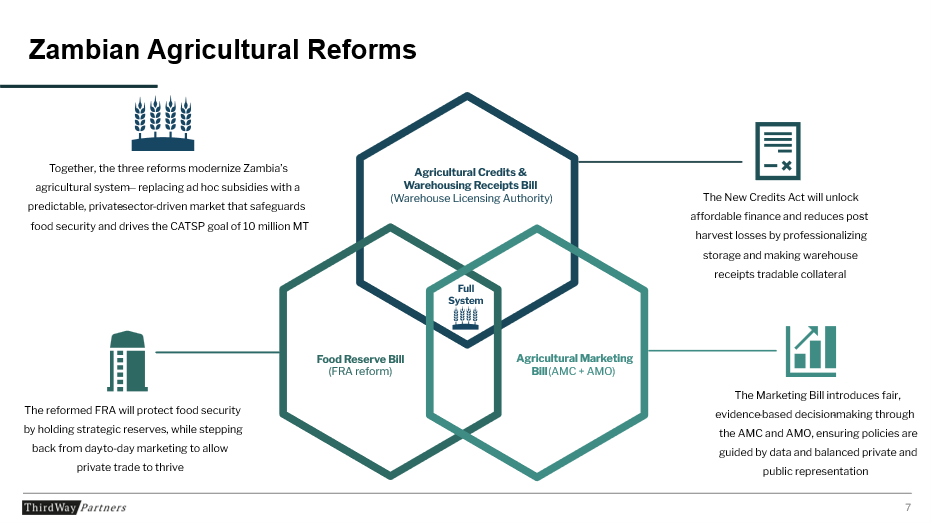
[Image: Zambia's agricultural reform centred around three crucial Acts of Parliament]
This has culminated in the tabling of three key Bills in Parliament, a significant milestone for a reform process that spans decades. Engagements were planned and tracked in line with Zambia's Parliamentary process to ensure key stakeholder involvement at every stage.
On the institutional front, two proposed bodies illustrate this clearly. The Agricultural Marketing Council is designed not only to provide regulatory clarity, but to formally seat private sector actors alongside government in shaping how agricultural markets are governed. The proposed Warehouse Receipt Authority goes further still, creating the infrastructure of trust that commercial lenders and grain traders need before they will commit substantial capital: a credible, government-backed system for verifying and trading stored commodities. These systems reduce the risk private actors currently absorb on their own.
Beyond new institutions, the reforms also seek to clarify mandates across existing government bodies. Where overlapping responsibilities have historically created uncertainty about who regulates what, cleaner lines of authority give private investors a more predictable operating environment, and predictability, more than any single incentive, is what unlocks long-term commercial commitment
Zambia is moving in the right direction. It is a forward-looking example, one that shows what becomes possible when a government commits to getting all three elements right together. The honest assessment of what was missing in earlier attempts, and the willingness to rebuild across policy, institutions, and private sector collaboration at once, is what sets this moment apart.
From ambition to delivery
Taken together, these examples point to a consistent pattern. Implementation-ready agricultural reform is not about lowering ambition. It is about recognising that ambition, strategy, and even good policy are not sufficient on their own. Without capable institutions, realistic sequencing, and meaningful private sector collaboration to unlock capital and co-invest in change, the agricultural sector will not be transformed, no matter how well-crafted the plan.
In practice, this means asking a different set of questions early in the reform process, and asking them across government, institutions, and the private sector together:
Who is responsible for delivery, and are those roles genuinely clear?
What incentives shape behaviour across institutions and are they aligned with the reform's goals?
Where does the private sector need to be at the table, and what would it take to get them there?
Where are the likely points of friction or delay, and how is sequencing designed to manage them?
What needs to work in the first year for reform credibility to hold?
Reforms that engage with these questions upfront are far more likely to translate from plans into results.
As this series continues, we will explore how these institutional dynamics intersect with access to finance, market systems, and investment, each of which plays a critical role in building sustainable food systems across the continent.